
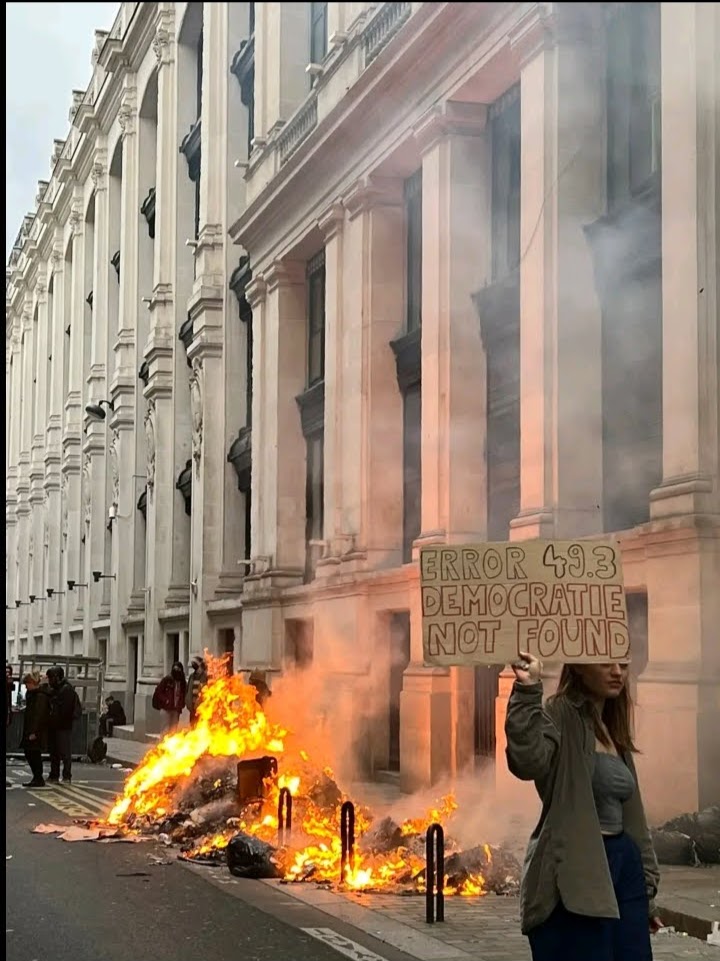
Over the last few months protestors and unions have taken to the streets of France, but recently these protests have escalated. This has sparked some to call for President Macron’s resignation, and others to start to label these latest series of protests the beginning of a revolution. These all stem from the pension reforms announced by the Prime Minister in January, the headline of which is an increase in the retirement age from 62 to 64.
Macron’s Past Reform Attempts
When first elected in 2017, one of Macron’s main policies was pension reform. And so, in 2019 he put forward a reform of several primary proposals. Firstly, getting rid of the 42 different special regimes for occupational sectors, in favour of a universal state retirement plan. Which would have removed the advantageous pensions belonging to some professions. In addition to creating a points-based system, where workers could buy points with their salary, and these points would be converted into a pension upon retirement. However, these proposals worried the unions that workers would be working longer for a lower pension, inequality between pensions would increase, and the general level of pensions would decrease.
This resulted in demonstrations and strikes beginning on the 5th of December 2019 by more than 30 unions. Culminating in the protesting of 800,000 people in over 100 French cities, according to the interior ministry. However, the General Confederation of Labour (CGT) trade union put the number at 1.5 million including 250,000 in Paris. This opposition was further reinforced when France’s largest trade union by number of members, the CFDT, announced it would be joining the demonstrations the day after the then Prime Minister, Édouard Philippe, officially announced the reforms. And many union leaders promised to continue striking until Macron withdrew these reforms.
Consequently, this became the longest French strike over the last 50 years, with Macron hoping specially to avoid a repeat of pension reforms in 1995, which saw a general strike cripple the transport system for weeks and gain huge public support. The strikes only ended primarily due to the Covid-19 pandemic which forced the reforms to be put to one side. With the unveiling of new plans being delayed by Macron until 10th January 2023 which brings us to the present day. But notably during the 2019 strikes, Macron’s government made slight concessions to the workers, creating 8 specialised plans for particular professions in an attempt to stop strikes in critical sectors like the police.
What are the new proposed reforms?
On 10th January, French Prime Minister Elisabeth Borne announced the headline change of increasing the retirement age from 62 to 64 by 2030 in the name of becoming “financially balanced”. This means an increase in the minimum age which one needs to reach to be entitled to a full pension by 3 months each year until 2030, but there are of course exceptions and caveats which I’ll discuss shortly.
Starting from 2027, people will have needed to work for at least 43 years before being entitled to a full pension. Therefore, this minimum age only applies to those who have fulfilled this condition of working enough years to qualify. Consequently, this unfairly disadvantages people who interrupted their careers to raise children, or people who undertook long periods of study and education before starting their careers. The people who do not meet this condition, and so will be required to work until 67 to retire without penalty. However, provisions for early retirement will still exist under the reforms for those who started working before the age of 20, and for specific occupations like police officers and firefighters.
Additionally, Borne included an increase of the minimum pension to 85% of the minimum wage, that is aimed to increase small pensions, but it will only impact 20,000 people according to the government.
After being abolished 10 years ago, the policy of phased retirement is being reintroduced for civil servants, meaning they will be allowed to become part-time 2 years before retirement. This is in addition to the maintaining of the long careers system and a few other exceptions to the minimum retirement age. The long careers system allows people who worked for five quarters before the age of 20 to retire two years before the minimum age, which will now increase to 62. And providing they have contributed the required insurance period plus one year (down from the currently required 2), people who started working before the age of 16 will continue to be able to retire at 58, and those who started between 16 and 18 will be able to retire at 60.
Another plan of this reform is the implementation of a senior index, in attempt to address the issue of employment rates of those aged between 55-64, which in France is below the European average. This index, modelled from the professional equality index between men and women which was introduced in 2019, will require companies with at least 300 employees to publish yearly reports regarding their employment and work in promoting the employment of senior citizens. Not only is it hoped this will encourage companies to employ this demographic, solving issues of comparatively low employment rates. But also, this index should provide the French government with data that will support their promotion of senior citizen employment and allow them to monitor the progress of companies.
The senior index will be an obligation for employers, which if not complied with will result in a fine, phrased by the reforms as a “contribution based on a percentage of the payroll” within a 1% limit. The funds received from these fines will be put into the National Old Age Insurance Fund (CNAV). In addition, any company which fails to increase the employment of older workers under the reforms will be subject to a “reinforced obligation to negotiate a labour agreement” that intends to ensure the improved employment rate of the demographic.
There is however opposition to the index from both employers and workers. MEDEF (a union representing employers that supports most of the reform’s proposals) has said they “fear that the tool proposed by the government will … impose severe constraints on companies”. Whereas trade unions say it is insufficient to make any real improvement unless backed by more significant financial penalties. The secretary general of the CGT union said it “is not an index that will scare the employers”, joined by the head of the CFE-CGC (a union for managers) who labelled the index a “little smoke screen”. This criticism has made the government willing to see this system evolve and develop with parliamentary debate and consultations with the unions.
Macron’s Reasoning and Justification
Ultimately, the reform proposal is of no surprise to anyone, as it has undergone suspensions and postponements. A spectre haunting France since Macron’s election in 2017 you may say. However, the reform is justified by Macron now with particular pertinence as he points to a September 2022 report from France’s Pension Advisory Council (COR) which found the pension system will run a deficit on average over the next 25 years. It reported a financial deterioration between 2023 and 2027, but showed the system returning to breaking even by the mid 2030s even without any reforms. Macron’s concern over a deficit is further compounded by government forecasts which predict an annual deficit of the pension system of €13.5bn by 2030 if there is a failure to act.
The primary reforms included are predicted to generate an additional €17.7bn in pension contributions by 2030. However, the French government also calculated that “accompanying measures” required to smooth the way would cost €4.8bn, which with the recent addition of more “measures” has increased to €6bn, resulting in searches for last-minute savings in an attempt to balance the books.
Overall, the French pension system costs almost 14% of GDP, which is the third highest in the Organisation for Economic Cooperation and Development behind only Italy and Greece.
And on 8th January 2023, Budget Minister Gabriel Attal said “Without reform, there will be €500 billion in additional debt over 25 years,” posing the ultimatum, “it’s reform or bankruptcy”. But this ultimatum may not be as persuasive as intended since people look to recent history, Covid-19, when hundreds of billions were borrowed to help the country survive – although during a time of unprecedented and extraordinary crisis.
Additionally, Macron’s determination to enact reform may be fuelled by the necessity to reassure the financial markets. On 4th January 2023, he told the Council of Ministers, “A few days ago, France borrowed above 3% (the interest rate on the borrowing), something that had not happened for years,”. French debt will soon reach €3 trillion and rising interest rates further compound the issue, resulting in an increase of the cost of the debt by €13 billion in 2022 to over €51 billion.
Considering the financing of France’s budget is as much borrowing as is tax, the issue is of upmost seriousness to Macron. A failure to implement this reform could be seen to be very risky by investors who facilitate France’s borrowing, resulting in a potential downgrading of French debt which would consequently see France paying higher interest debts, making their borrowing even more unaffordable. To British readers especially, this seems like a harrowing rumination of Liz Truss’ leadership, which while outlasted by a lettuce, whose mini-budget managed £30bn in damage to the UK economy. Caused by a combination of unfunded tax cuts and irresponsible promises, and exacerbated by the increased interest rates on UK government borrowing – which France is likely to now experience. Also particularly resonant to British readers, Macron’s address to the Council of Ministers included encouragement to “find savings areas”, a phrase recklessly used by the UK government since 2010 to justify the horrific policy of Austerity that has inflicted and continues to inflict nothing but destruction on everything it touched.
Alternatively, some French MPs belonging to far-right parties have blamed the European Union for the reform. On the 11th January, prominent French MP Marine Le Pen (former leader of the far-right party Rassemblement National) labelled the reforms the result of “a form of blackmail” from Brussels. And the very next day, French MP Nicolas Dupont-Aignan of the far-right party Debout la France tweeted, “The pension reform is a specific recommendation of the Council of the EU and the government is submitting!”.
This only has some partial truth however, as it’s true that recommendations were made by the EU in 2019 to “reform the pension system to progressively unify the rules of the different pension regimes, with the view to enhance their fairness and sustainability”. This was done in the context of the annual attempt to coordinate public and economic policy within the framework of the European Semester. Additionally, the commitment to reform was reinforced in 2021 when France submitted its national recovery and resilience plan to the European Commission. Investments facilitated by the European recovery plan were specified to be “accompanied by reforms … [which] when conditions allow, [will include] the pension system”.
But given these recommendations is it fair to say that the reforms were imposed by Brussels as some have claimed? Quite simply, no, given that these recommendations were made as the result of discussions with the member states and the commission aiming to help achieve objectives. In addition to the fact that the recommendations made in 2019 were already on the French government’s agenda, as explored above, and no specific or precise plans or time frames were included in the recommendation removing any formal obligation. This is ultimately accentuated by the absence of a specific mention of pension reforms in the “Targets and Milestones” section of the 2021 recovery and resilience plan, which includes many other specific targets such as helping 700,000 households to renovate their homes to increase energy efficiency.
However, some French MPs who usually align with Macron are of the opinion that the government has failed in adequately explaining to the public the purpose of the reforms. And in a climate of rising inflation, soaring energy bills, and an overall social climate in an adverse state, Macron will need the support of workers – not just those currently retired who generally favour the reforms.
The significant cost, the forecasted deficits, and the whole host of reasons Macron has argued are unlikely to persuade people, who currently enjoy the safety of a system which ensures one of the lowest rates of poverty risk for pensioners in Europe.
Bypassing the National Assembly
In June 2022, elections were held in France for members of its national assembly. Unfortunately for Macron, who had only recently won the presidential election in April 2022, his party lost their absolute majority in the national assembly. This resulted in a hung parliament for the first time since 1988 as no coalition could be formed to establish a majority. Therefore, Macron’s confidence in passing the reform bill through the national assembly was severely lacking.
As a result, to ensure the smooth passage of the reforms, it was announced by Élisabeth Borne on Thursday 16th of March in the National Assembly that Article 49.3 would be invoked. The announcement was met by chaos, in which left-wing lawmakers sang La Marseillaise, the French national anthem, as loudly as possible attempting to prevent the prime minister from speaking while far-right lawmakers from the Rassemblement National party shouted “Resignation, resignation!”. This marks the 11th usage of the article since Macron began his second term last year, compared with only 1 usage during his first term (2017-2022), exemplifying the instability and ineffectiveness of the current French political situation.
But what actually is Article 49.3 of the French constitution? The article provides the government with powers to force a bill through the national assembly without a vote, which as per a 2008 constitutional reform, can only be done once a parliamentary session. As an exception, there are no restrictions on its use for the state budget and the social security budget. However, the power is only exercisable “after deliberation by the Council of Ministers”.
Ultimately the use of the article is a big political gamble. This is because after the triggering of the power by the Prime Minister, MPs have 24 hours to table a motion of no confidence in the government. If the motion doesn’t achieve a majority and so fails, the government’s gamble pays off and the law passes. But if the motion gains a majority, then the government effectively collapses, all government ministers including the prime minister resign, leaving the most suitable course of action to be the President calling early National Assembly elections – with the bill evidently being rejected.
In this case, the use of Article 49.3 has resulted in outrage. The leader of the Socialist Party, Olivier Faure, commented, “When a president has no majority in the country, no majority in the National Assembly, he must withdraw his bill”. Marine Le Pen, who was previously mentioned, also labelled this “a total failure for the government”. Additionally, the leader of the CGT union, Philippe Martinez, warned that this action meant “giving the keys of the Elysée” to Le Pen in the next presidential election.
But before that could even happen, on Saturday 11th March, the upper house, the senate, voted by 195 to 112 to pass the bill, meaning the reforms were one step closer to becoming law and being adopted.
And on Friday 14th April, the French Constitutional Council approved the proposed reforms, which meant Macron could sign the reforms into law as he did shortly after. However, the council rejected some parts of the reform, the six concessions made by the government to the unions – which includes the previously explained senior index – making what for them was already unfair “even more unbalanced”.
On Wednesday 3rd May, the Constitutional Council for a second time ruled against a request from 253 left-wing and centrist opposition lawmakers who aimed to “forbid a minimum retirement age of over 62” by means of a referendum under Article 11 of the French Constitution. The bill proposed by opposition lawmakers was rejected for two primary reasons. The first concerned article 1 of the bill, which intended to forbid the minimum retirement age being over 62. Crucially, any referendum held must concern reforms to economic, social, or environmental policy, which since the proposal was filed the day before the reform was enacted by the government, the retirement age was still 62 -not yet 64 – and so the council held it wasn’t a reform. And secondly, article 2 of the proposed bill which aimed to increase social security contributions from certain types of income coming from assets, like capital gains, dividends etc, from 9.2% to 19.2% to finance the pension system. This was also rejected by the Constitutional Council on the basis that this proposal was strictly economic, not a social reform.
The ruling has not convinced the main proponents of the referendum however, as the Socialist Party continue to view it as “one of the solutions for [the] country to emerge from the social and democratic crisis it has been plunged into by the executive for the past four months”.
On the Verge of Another Revolution
Within 24 hours of Article 49.3 being utilised by Élisabeth Borne, 2 motions of no confidence had been filed. One by a cross-party alliance of the left-wing parliamentary group NUPES and the regionalist group LIOT, the other by the far-right party Rassemblement National. On 20th March both motions failed to reach a majority, with the cross-party motion being most effective and only failing by a margin of 9 votes – a result that was almost certainly too close for comfort for the government.
These reforms have attracted a united front from trade unions and many other social movements, especially youth groups, demonstrating their adamant determination in opposition. The unions criticise the reforms for numerous reasons, they argue the reform will penalise low-income people who tend to start their careers early, forcing them to work longer than graduates, who are less affected by the changes.
Additionally, the reforms have been branded “anti-women” by the opposition, given that a government report showed that women would have to postpone their retirement for longer than men. For example, if born in 1966, a woman would have to postpone their retirement by seven months compared to five months for men; and in 1972, nine months compared to five months; and in 1980, eight months compared to four months.
This criticism has only been validated by the admission that “Women are obviously penalised a little” from Franck Riester, the Minister Delegate for Parliamentary Relations, on 23 January. As well as the transport minister Clément Beaune saying that “sometimes, the jump will be a little bit bigger” for women. Which compounds and exacerbates the existing gender inequality in pensions, since women already retire later with pensions 40% lower in comparison.
Polling consistently continues to display the unpopularity of the reforms amongst the French population, joined by Macron’s approval ratings reaching a low comparable to previous yellow vest/jacket protests – with 71% currently dissatisfied with him.
Furthermore, many argue that Macron is prioritising businesses and the highly paid over the working classes, and is enforcing a burden on the working classes due to a refusal to increase taxes on the wealthy. Many also dispute the sense of urgency generated by Macron in introducing this reform since the financial problems and struggles, which he claims are certain without reform, seem difficult to predict and a long way away to many. This sense of urgency coupled with the current cost of living crisis is undoubtedly sparking worsened and wider resistance, leading some to doubt the sensibility of such a reform in such a political and economic climate.
The first strikes were co-ordinated to begin on 19th January, this first day saw 200 demonstrations across France with 2 million participants according to the unions. Many more days of national protests followed, these are the dates and the number of participants according to the unions: 31st January – 2.8 million, 7th February – 2 million, 11th February – 2.5 million, 16th February – 1.3 million, 11-12th March 1.1 to 1.4 million, 15th March – 1.78 million.
Prior to the use of Article 49.3 on 16th March, actions by striking workers had seen national power production reduced by 14% and maintenance blocked on 6 nuclear reactors on Saturday 11th March. The strikes of workers had caused major disruption to rubbish collection, airports, public transport, schools, TV stations, energy production, fuel deliveries and many other sectors.
After the invocation of Article 49.3, protesters and police escalated their tactics, marking a turning point in response to a complete denial of democracy and a show of contempt towards the people as the unions claimed. On the evening of the 16th March, protesters in Paris had lit a bonfire followed by smaller fires to which the police responded with water cannons and tear gas. Reportedly, 258 people had been arrested in Paris that evening.
On 17th March, protest chants of “tax the rich” and “we decapitated Louis XVI and we can start again, Macron” went viral of social media. And the head of the CFDT union said a change in government or Prime Minister “will not put out this fire, only withdrawing the reform”. The CGT union also announced an extension of its picket lines, targeting energy production and fuel refining companies with TotalEnergies reporting 37% of its operational staff were on strike.
By 22nd March, 13% of petrol stations were facing shortages due to blockades of oil refineries. And by 23rd March this number had increased to 14% with 7% completely empty, in addition 40-50% of primary school teachers had also gone on strike according to the unions including 15% of high school teachers and exam supervisors.
These protests and strikes continue, and the escalation into increasingly radical tactics by protesters has worried some, especially as protesters display no sign of wavering.
Moreover, many concerns have been raised over the policing of the protests which has received criticism by The Council of Europe which condemned France’s crackdown on protests and warned that sporadic acts of violence could not justify “excessive use of force by agents of the state”. Other criticism was offered by Clément Voule, the UN Special Rapporteur on Freedom of Association, who tweeted, “peaceful demonstrations are a fundamental right that the authorities must guarantee and protect. Law enforcement officers must facilitate them and avoid excessive use of force”. Human Rights Watch also said it was very concerned about “what appears to be abusive police practices”.
My Concluding Thoughts
Ultimately, I believe the issue of pension reform is representative of something much bigger, issues of economics, yes of course, but also those of fundamental democracy.
As evidenced by the UK, the way Macron is going to resolve the economic situation is never going to be the current policy of burdening the working people, it will be the taxation of the wealthiest as seen in the windfall tax introduced in Spain.
And on issues of fundamental democracy, I predict the people of France will not be very forgiving, but this has some worries attached to it. These worries originate in the potential growth in popularity of far-right parties and policies due to the observed weakness of democracy. This weakness may in itself give power to far-right parties due to a possible increased dependency on them to pass laws from Macron, although the far-right seems quite reluctant to be seen cooperating with him, making clear the pension reform was an agreement of circumstance not of government.
Whatever your opinions on the right or wrongs of this reform, it is evident that the issue at stake has evolved and is no longer so simple. This series of protests originated to contest Macron’s pension reforms, but has now emerged into something much more, the defence of French democracy.

 Teen Politics
Leave a comment