
Please note: featured image credited to Right Livelihood
My sincere apologies for the distinct lack of posts recently. But this article titled ‘The History of Protest’ is the transcription of the keynote speech of the same name I was fortunate enough to give on 1st December 2023 at Amnesty International UK’s 2023 Youth Conference. Hope you enjoy!
What makes a Protest?
Before delving into the history, I feel it’s necessary to establish what we really mean by a protest. Quite honestly I think Cambridge Dictionary does a decent job – “a strong complaint expressing disagreement, disapproval, or opposition”. With this definition however, it’s necessary to highlight and remember the scale of protest, while protest does indeed cover the international movements we see all so often on the news, it also includes local protests for local issues. Including everything from trying to save a crucial local bus stop to ensuring the bins are collected properly. But fundamentally, I believe this neglects the answer to the question I have posed: the people, for there is no protest without its campaigners and supporters, their fight and their struggle.
Additionally, it’s important to remember, as you learnt earlier today, abiding by this definition of protest doesn’t necessarily mean an act of opposition is innately effective – so I’d like to give you an example from history that most certainly was.
Historical Protest and Its Impacts
In this section, I’m going to tell you the lesser-known story of the Committee of Soldiers’ Mothers of Russia, not only in the hope that you might learn something new, and in my view incredibly interesting, but that it may also provide you with some inspiration – showing you that anybody passionate about an issue can start a campaign and make it successful, you don’t have to be a political or campaigning expert to do so.
Formed in 1989 by 5 women, the committee became the very first women’s NGO in the USSR concerned with military issues. The era of Gorbachev’s perestroika – restructuring – and glasnost – openness – meant that mothers began to look past the “Iron Curtain” of Soviet military power structures. They were horrified by the emerging realities which their sons experienced, and so organised, initially, against the 2-year mandatory military service. But this expanded to include advocacy for reform of military structures, democratic reform of the armed forces, demilitarisation of the justice system, and human rights education.
The key issue they challenged was dedovshchina – the system of informal power hierarchies and its associated violence in Soviet barracks amongst conscripts consisting of humiliation, abuse, and beatings. This was further compounded by inhumane barrack conditions and the effective slavery imposed by ‘construction’ or stroibat battalions, which comprised about 30% of the military workforce. As a result, the seeming inability to maintain order of barracks during peacetime cast serious doubts over the operational capabilities of the formerly revered Soviet army, in addition to significantly changing public perception of military service, even motivating some to evade conscription. Ultimately, the mothers’ astonishment and outrage was encapsulated by knowing that on average 5,000 young soldiers died due to hunger, illnesses, beatings, suicide, murder, and trauma each year. From this, the committee understood that they had to undertake a campaign for human rights, in doing so they realised that in this call to defend their children they have to change the state and the society. And their call for human rights in all the military power structures meant a call for democracy. Therefore, commanded by such a task, they established a human rights school for future soldiers and their parents which took place for years every Monday in conference halls, or even on the streets. They also built a network of working contacts in various military state structures to help resolve the 10,000 individual complaints they received about human rights violations per year. In addition to setting up a Rehabilitation Centre for soldiers discharged due to health reasons and conducting regular inspections of army barracks. On top of all this, the committee passionately lobbied for public access to barracks, decriminalising desertion on self-defence grounds, and abolition of stroibat – the horrific ‘construction’ battalions. However, throughout all of their activities, non-violence remained a fundamental principle.
With the outbreak of war in Chechnya in late 1994, the committee saw it as a natural continuation of their human rights advocacy to oppose the war. And they campaigned relentlessly to put a stop to the war, and in their own words, “uncompromisingly against violations of human rights of every human being involved in the conflict regardless of any kind of ethnic, national, religious, and other social divisions”. Their first anti-war vigil occurred in January 1995, with many more to come over the course of the war, which attracted solidarity from other groups, notably Buddhists. The committee was also heavily involved in prisoner exchanges, for example in January of the same year, a group of soldiers’ mothers led by Maria Kirbasova entered a Chechen military zone and ended up staying there for just over a month. A form of admittedly quite dangerous intervention, which enabled them to confront and negotiate with Russian military commanders, resulting in the release of dozens of soldiers. They also sought to bring humanitarian aid to Chechen civilians and rehabilitate wounded Russian soldiers. This was done alongside encouraging soldiers’ mothers to collect their sons from federal military units before reaching the front lines, assisting conscientious objectors to avoid criminal punishment, and allowing mothers to take their sons home who had been taken as prisoners of war by the Chechens.
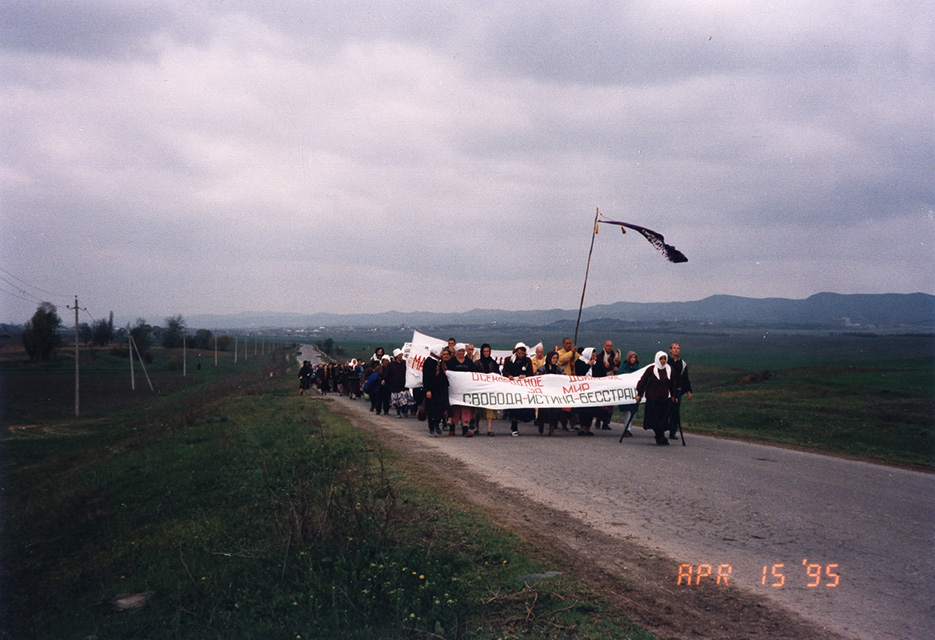
But of all their acts of protest, their most notable was the March of Mothers’ Compassion. It saw 100 women intend to march from Moscow to Grozny where they hoped to obtain information and negotiate the release of Russian soldiers, all the while raising awareness of the war’s atrocities and human rights violations. Unfortunately, but possibly unsurprisingly, the Soviet authorities didn’t afford them free passage and caused disruption, ultimately this was overcome, with the now more than 100 women reaching the border town of Samashki, and then finally Grozny – where joined by Chechen mothers and Buddhist monks, they marched for peace.
While their tireless campaigning and its significant impact is evident, they undoubtedly faced challenges. Primarily, and expectedly, the military was not at all happy with the volume of public commentary and criticism of military affairs, which along with the spontaneous inspections of military units by soldiers’ mothers, the military viewed as an unacceptable intrusion. Struggling to reinforce the previously long-enjoyed separation of military affairs from the civilian world, the Soviet army was determined to delegitimise the mothers’ commentary on the military. In order to do so they concocted a series of malicious and ultimately misogynistic media narratives. One favourite of theirs was to blame the mothers’ anger on female hysteria and overreaction, in doing so they also argued for eradicating media coverage of military affairs. The Soviet military also sought to insist that, in the words of one military spokesperson, “only military people should read this, they understand it and are in a position to draw the correct conclusions; but there’s no need to frighten the mammas and grandmothers”. Unfortunately, such a narrative was only reinforced by the wider media, with common depictions of the mothers as ignorant, politically illiterate, and only concerned with their personal and emotional interests. However, the challenges did not stop there. Another tactic included the hinting that the mothers’ campaign was the product of subversive political forces – in Russia they were masterminded by democrats, while in the smaller republics by nationalist-separatist extremists – since it was argued their emotionality and hysteria made them vulnerable. This image made it easy for the Soviet army to dismiss issues of dedovshchina as a ploy of anti-army forces, with even the Soviet Defence Minister, Yazov, contributing – saying that the mothers used dedovshchina “to conceal both unlawful actions and far-reaching political goals”.
Despite all this, it was crucial to the successes of the committee, which I’ll come to very shortly, that women were organising and campaigning instead of men. This is due to the soviet cult of motherhood which the committee utilised to their advantage, their semi-sacred positions as the soldiers’ mothers meant the military didn’t dare directly attack the committee. Additionally, men would have been much more vulnerable to retaliation since they could be called up to active service at any time – and therefore easily harassed. But also, it was felt that women had the psychological and moral upper hand in dealing with the authorities, as officers didn’t know how to respond to unprecedentedly assertive women.
Ultimately the committee managed to bring 180,000 young soldiers home, encourage and facilitate peace in both Chechen Wars, hold Soviet military apparatus to account. And overall be a beacon of democracy and human rights despite all the odds and opposition, work which very much still carries on to this day, and work which has earned them the Rafto Prize and the Right Livelihood Award. Unfortunately, in 2014 the organisation was labelled a “foreign agent” by the Putin regime, leading to a significant reduction in possible actions, although it still does what it can.
The Evolution of Protest
But in order to really apply the lessons of previous protests, we must address how the fundamentals of protest movements have evolved over history.
While the decision to take it is one of a serious last resort in which all other methods have been exhausted, we can observe the effectiveness of extreme direct action, a good example being hunger strikes. They were practised by the suffragettes, whose notorious hunger strikes in prison led to the implementation of the cat and mouse laws in addition to forced feedings; revealing the true brutality of the government at the time, attracting sympathy and popularity for their cause, and inspiring protest movements over a century later. One example of that is Richard Ratcliffe’s 21-day hunger strike outside the Foreign Office in 2021 against the UK government’s “inaction and failure” over Nazanin Zaghari-Ratcliffe’s detention by Iranian authorities since 2016. An act which attracted significant public and also parliamentary solidarity, but also exposed the neglect of the case by the UK Government.
However, now I’d like to move on to analysing more accessible forms of protest, the key to doing so, and in my view the fundamentals of all protest movements, I have coined the three ‘tions – education, mobilisation, and organisation.
Let me start with education. In every protest movement, it has been and must be a priority to have informed participants to enable education and raise awareness of the issue to a wider audience. The foundation of education in protest movements not only extends to raising awareness but also provides legitimacy to a cause. To look at the evolution of education as an element of protest, the first example I’d like to draw your attention to is the Students for a Democratic Society’s “Teach-Ins” which emerged to organise and inform students about American involvement in the Vietnam War. The first “teach-in” happened in March 1965 at the University of Michigan, attended by 3500 people, the event involved debates, lectures, movies, and musical events designed to protest the war. The idea inspired 35 more “teach-ins” on US college campuses in the next week alone. These events not only constituted an innovative form of protest but arguably more importantly harnessed the knowledge of university professors and academics to educate students, ensuring informed participants.
If we now take the more recent example of the Black Lives Matter protests, the significant use of social media during the height of its protests in 2020 revealed the true power of social media as an effective educational platform. In educational terms, social media was such an effective tool primarily due to its ability to reach a global audience which in turn facilitated improved sharing and accessibility of educational resources and people’s experiences, ultimately empowering a movement of equally informed participants globally – a great example of all 3 ‘tions on an international scale.
But comparatively, as an evolution, the theme of equality in education remains consistent to protests, confirming that an effective protest movement demands all participants to be informed. However, the evolution of social media platforms provides significant benefits, particularly in terms of accessibility, since these platforms continue to harness the knowledge of academics and lecturers like in the teach-ins, but are able to facilitate global accessibility. This evolution also serves to enhance the legitimacy of movements, which improves as a by-product of well-informed participants. Therefore, currently developing and future protest movements must take full advantage of social media’s accessibility to ensure informed participants, and consequently to also improve and demonstrate legitimacy.
The second ‘tion, mobilisation, concerns the necessary ability of protest movements to engage the public and motivate supporters to act. For discussing mobilisation, I first wish to draw your attention back to the example of Students for a Democratic Society. When looked at in terms of mobilisation, the methods of engagement primarily consisted of the previously mentioned educational teach-ins, rallies, and speeches. But the Students for a Democratic Society also had an attractive, passionate, and energetic leadership absent of any single political doctrine, in addition to a clear and direct manifesto. The first line of which read “We are people of this generation, bred in at least modest comfort, housed now in universities, looking uncomfortably to the world we inherit”. While the former methods served an educational and ultimately mobilising purpose, the latter also enabled the organisation to gather supporters on a wider basis than specific issues. This allowed the performance of large-scale protests by the students, such as the October 1967 rally of 100,000 people at the Lincoln Memorial. In addition to contributing to what was the largest anti-war protest in American history at the time, a 500,000-person march on Washington D.C. in November 1969. However, the significant role of organisation in underpinning the possibility of these actions must be recognised, in addition to the necessary education to ensure the passionate and informed nature of participants, again illustrating how the three ‘tions interdepend.
The modern example that in my view best demonstrates the power and necessity of mobilisation is the School Strike for Climate, which similarly to BLM cleverly harnessed the power of social media to educate and facilitate mobilisation. And crucially to the movement, Greta Thunberg represented the first high-profile protestor whose actions served to inspire schoolchildren globally and to demonstrate that the movement required action beyond social media. Therefore, Greta’s inspiring protest combined with the international solidarity cultivated from the online movement meant supporters could be mobilised into action. One brilliant example is what is thought to be the largest climate strikes in world history during the 2019 Global Week for Future which consisted of 4,500 strikes in over 150 countries involving an estimated 4 million participants. Once again similarly to BLM, mobilisation on such a scale was not possible without the platform provided by social media, consequently social media benefits all aspects of a campaign, but some issues arise in terms of mobilisation. While as previously highlighted, social media remains an important facilitator of education, as it was to the School Strike for Climate who were able to make climate science research understandable and accessible, ultimately informed participants are only useful to a campaign if they can be mobilised into actions. As a result, the primary drawback to social media’s mobilising ability is the presence of performative activism, which exists not as real care and devotion for social justice issues, but instead superficially as a means to gain social validation or praise. On such a basis, the task of translating social media posts into recognised acts of protest must be of utmost pertinence to all movements to ensure decision-makers realise the true importance of issues beyond tweets and posts they can scroll right past and ignore. And this is where organisation comes into play.
The 3rd ‘tion, organisation, underpins the necessary unity of a movement’s activists and aims, which also extends to the solidarity between movements. And my first example for organisation is, Students for a Democratic Society. They were organised in chapters, primarily at different educational institutions like universities, colleges, etc. This devolved structural approach gave more power to the members to specifically address issues relevant to them, but didn’t prevent coordinated strike action nationwide – evident in the Student Strike which began in May 1970 involving over 900 college campuses in response to Nixon’s expansion of the Vietnam War into Cambodia, and ultimately exacerbated by the Kent State Shooting on 4th May. However, another key aspect of the organisation of the SDS was the solidarity displayed with other anti-war organisations such as Vietnam Veterans Against the War. Different campaigns also found common struggles, demonstrated by the civil rights movement and Martin Luther King Jr joining the anti-war movement in 1967, bringing their own perspective, but also empowering the movement with their solidarity. In my view, displaying the necessary unity amongst student activists, but also amongst movements to stand together on an issue which impacts them all.
As you may be able to guess, the modern example I’m going to use is the School Strike for Climate. In this case, organisation unified climate activists worldwide, allowing strikes to be coordinated internationally, a scale which undoubtedly bolstered the impact of the movement’s protests. Ensuring the highlighting of diverse impacts of climate change varying from region to region were empowered, presenting a unified and therefore powerful case for combatting climate change. This prevented the division of activists into highly localised and specific campaigns, which while maybe particularly relevant to their region, would not have produced such an influential campaign. I believe this represents the necessity of global solidarity not only for empowerment, but also especially for issues such as climate change, due to the global nature of its impacts. And it is this global scale of organisation which the use of social media has demonstrated and will demonstrate to be an extremely powerful tool. However, despite social media providing a great platform for organising, we must also consider the impacts of performative activism in preventing a serious, sustained, and effective campaign, as well as the division which social media often causes. Since these are ultimately detrimental actions, undermining the principle of unity of both activists and aims, inhibiting our ability to stand together on common ground with other campaigns, and therefore diminishing the power of our collective struggles.
Just before I finish this section, a brilliant example of cross-issue solidarity, which may have some relevance and application to the political situation we find ourselves in now, is the formation of the organisation Lesbians and Gays Support the Miners (LGSM). Formed during the Miner’s Strike in 1984&5, the organisation realised the common struggles the LGBTQ+ community shared with the miners at the time, writing “if this strike isn’t won, we as Lesbians and Gays have a lot to lose when the Tories and their henchmen come for us”. This act of solidarity was then reciprocated by the National Miners’ Union when they stood with the LGBTQ+ community against Thatcher’s implementation of Section 28 – which was intended to prohibit the supposed ‘promotion of homosexuality’.
The Challenges of Protesting Today
Unfortunately, today we are forced to consider the growing challenges to future protests’ effectiveness, but also our fundamental right to protest. As I’m sure many of you know, or have at least heard, recent laws such as the Police, Crime, Sentencing, and Courts Act and the Public Order Act have imposed significant restrictions on protests – creating offences of intentionally or recklessly causing a public nuisance, locking on, and interfering with the use or operation of key national infrastructure, amongst many others – which unarguably threaten and possibly undermine our right to protest. A right not only established under Article 10 of the Human Rights Act, but also specifically for children as per Articles 12, 13, and 15 of the United Nations Convention on the Rights of the Child – the UN committee responsible for ensuring the convention’s implementation has even expressed concern about the ‘chilling effect of counter-terrorism measures on the right of children to freedom of expression.
Politically, this legislation embeds the current government’s ambition to suppress opposition, meaning these legal implications of protest manifest the heightened hostility towards protest. As a result, we have to ask, is protesting safe? A question which in my view reflects the dire state of a democratic society, but one which is unfortunately highly relevant, since it is becoming increasingly difficult to give a confident or definitive answer. But also since safety should be the top priority when considering protest, as there are many other ways to campaign and effect change, and a movement will not be able to display power in and galvanise support for a protest which people are potentially scared to attend. Fortunately, there are many other crucial parts to campaigning, which for the moment at least we can be confident in their safety. However, this does not mean the practicalities of these safer forms of protest will be absent of similar challenges.
Especially as young people, I strongly suspect any form of political campaigning will attract some of the same fundamentally discriminatory criticisms faced by the Committee of Soldiers’ Mothers of Russia. We should anticipate and combat the labelling of young people, and all other groups for that matter, as politically illiterate and ignorant, a stereotype we all prove false simply by being here today.
I’d also like to reiterate the point about social media, while it is a fantastic tool that we all perhaps spend a bit too much time on than we would like to admit, as mentioned previously I would suggest it poses several challenges to protesting and campaigning. Primarily in the form of performative activism, preventing a campaign from being effectively sustained, mobilised, and organised. However, in addition to this, I think we have all witnessed the highly divisive nature of social media occasionally. An issue which I believe is symptomatic of the widespread, fundamental issue of political polarisation, meaning many issues we may strive to change have been dominated by the entrenchment of either side in their beliefs with fading willingness to engage in debate and discussion. An attitude which risks the vital role of education in a campaign, hindering the legitimacy and the effectiveness of a campaign, since people will only be convinced to support a campaign due to respectful, meaningful, and nuanced discussion, not intolerance.
What’s at Stake?
Perhaps obviously, protest is not done without reason, or purely for the fun of it. Protest embodies an act of necessity due to the urgency of the issue at hand – therefore when considering protest as an option, we must balance the above challenges with the importance of its subject – in other words – what’s at stake?
For Greta Thunberg and then the School Strikes for Climate, horrified and worried at the continual neglect of environmental issues, such an imposing threat made clear to them the momentous gravity of the situation. A situation which gave them an easy answer to what was at stake, and for them justified striking – as they made clear there is no school on a dead planet.
For Black Lives Matter protesters, the racism institutionalised in policing established the stake of the issue well, meaning these protests were absolutely necessary in a time of covid-19 lockdown restrictions.
But for us, these issues amongst many others remain pertinent, and it is an unfortunate reality that many more issues are becoming increasingly serious and urgent, demanding protest. Yet the potential consequences have also become increasingly serious, so answering the question of what’s at stake and finding a balance has also become progressively more difficult. We are unlikely to be happy with the balance we are forced to strike, but in the face of the heightened hostility we are experiencing, it is a balance we must expect to endure. Especially as the only political prospect of change on the horizon is in the wrong direction.
And so, the question of what’s at stake becomes evident for me, more than the mountain of urgent issues, it is our very right to protest and ask this question, which currently answers it.
The Importance of Protesting Today
It is this answer which underpins the importance of protesting today. But all issues, big or small, local or international, will demand of us education, mobilisation, and organisation – which now more than ever requires solidarity in our struggles to enshrine common goals.
The power illustrated by the Committee of Soldiers’ Mothers of Russia, Students for a Democratic Society, and all the other examples I have mentioned, demonstrates the vital role protesting has played in historical change. Which now, as the generation looking uncomfortably at the future we inherit, we have the power to replicate.

 Teen Politics
Leave a comment