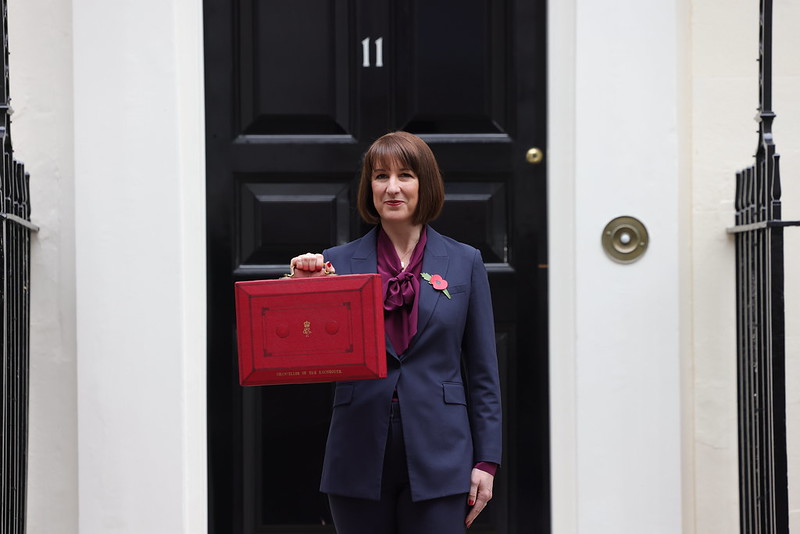
Please note: featured image credited to HM Treasury
This is my first substack post, so please also subscribe over there to receive more frequent updates on the world of politics, but don’t worry, the usual deep dive articles will also appear on the blog (more frequently than recently, I promise).
Tomorrow, Wednesday 30th October, has been a long time coming in the Chancellor, Rachel Reeves’, calendar. She will announce the first budget of the new Labour government, setting out the Office for Budget Responsibility’s (OBR) new economic forecasts for the country, and how she intends to tackle the £22bn ‘black hole’ left by the previous Tory government. Overall, however, she presides over a total government spend of £1.2trn compared to income of £1.1trn, so the question which plagues her now and has done so to every Chancellor previously is: how should that gap be closed?
Whether it’s helpful or not, unsurprisingly, the rumour mill has been in full operation in anticipation of tomorrow, meaning it is easy to speculate about potential spending commitments or cuts, tax rises, and any other “tough decisions”.
What Do We Know Already?
As a bit of a spoiler, yesterday, Keir Starmer did confirm some contents of the budget. So it can be said with confidence that Rachel Reeves will set out:
- A pledge of £240m in funding for services which help people who are disabled or long-term sick get back into work, providing work, skills, and health support. This is all in an effort to “get Britain working” according to the Prime Minister.
- A replacement of the £2 cap on bus fares, which began at the start of 2023, in favour of a £3 cap until the end of 2025. Perhaps attempting to decrease the cost of the scheme, which has been £500m so far.
Whilst in the grand scheme of announcements, these pledges will most likely amount to minor news, they will undoubtedly have a significant impact in the longer term, primarily on those poorest in society depending on the bus fare cap.
I hope this does not set the tone for the rest of the budget, but the first pledge regarding aims to “get Britain working” is not at all reassuring on the surface. Such rhetoric is highly reminiscent and similar to that of successive previous Tory governments, hyper fixated on economic (in)activity, with a distinct lack of humanity.
Although, even in their short term of power so far, this is not the first time such rhetoric has been promoted by Labour. Earlier this month, Liz Kendall, the Secretary of State for Work and Pensions, suggested that Department for Work and Pensions (DWP) employment advisers should be sent to visit mental health patients, helping the inpatients get back to work. But as May Gabriel from Just Treatment (a patient advocacy organisation) pointed out, “The narrative behind it is: your only purpose is productivity”. Fundamentally, both Gabriel and Mikey Erhardt, from Disability Rights UK, make clear the truly “dangerous” nature of this rhetoric and approach. A societal problem summarised by Erhardt as “we’re not saying: ‘why are people in these circumstances unable to work? Instead, the dominant narrative is that if you can’t work, there’s something wrong with you that you need to change on a personal level”.
Furthermore, Rachel Reeves has called the NHS “the lifeblood of Britain”, promising an end to 14 years of “neglect and underinvestment”. Therefore, extra NHS investment is extremely likely to be announced, with only speculative figures available at the moment. However, the Chancellor has also made clear her budget is unlikely to “undo 14 years of damage”. And even the Health Secretary, Wes Streeting, has admitted that extra money will not go far enough as to prevent avoidable deaths and a winter crisis.
More money is also expected for rebuilding crumbling schools (£1.4bn), the expansion of government-funded childcare (£1.8bn), and to help build up to 5,000 new social homes (£500m).
Additionally, as I write this, another of tomorrow’s announcements have been confirmed, the National Living Wage will rise from £11.44 to £12.21 in April next year, a big change which seemingly just couldn’t wait to be revealed. While initial reactions appear generally welcoming of any increase, some have voiced concerns over whether the increase goes far enough, questioning the real difference that will be felt as prices have risen dramatically in the past few years. But this living wage increase aligns very much with Labour’s prioritisation of “working people” (which they have avoided specifically defining). And as the National Living Wage only applies to those aged 21+, those 18-20 will have to rely on the increase of the minimum wage from £7.49 to £10, but as a result a question of blatant age discrimination arises if people are doing the same work in the same economic climate. The General Secretary of the Trades Union Congress, Paul Nowak, commented that the increase will “make a real difference to the lowest paid in this country at a time when rents, bills, and mortgages are high”.
What does the Rumour Mill Say?
Well in the face of a £22bn ‘black hole’ in public spending (which it has been reported may even be closer to £40bn), there are plenty of rumours about how Reeves will make this the ‘biggest tax-raising budget ever’.
The Chancellor is constrained by Labour’s manifesto commitment to not increase income tax, national insurance, or VAT for ‘working people’. Although, Reeves is expected to freeze the income tax thresholds for a further 2 years to 2030, after the Tories extended the freeze to 2028. This freezing leads to a phenomenon called ‘fiscal drag’, where the thresholds don’t change as people’s pay increases to catch up with inflation, meaning people’s taxable income increases, so people are ‘dragged’ into paying a higher tax rate. Therefore, increasing taxation revenues for the Chancellor.
It is also strongly suspected businesses’ employer national insurance contribution (currently 13.8% on a worker’s earnings above £175/week) will increase by 2 percentage points, whilst lowering the threshold from which employers start to pay the tax. Combined, these changes could raise roughly £20bn, which would likely in part contribute to increased NHS funding and helping to fill that ‘black hole’.
It is also rumoured that Reeves will be adjusting the inherited fiscal rules about how government money can be spent to exclude investment spending, facilitating greater government borrowing for increased investment in crumbling public infrastructure.
While the above list isn’t by any means exhaustive, will it be enough? We simply won’t know until all is revealed at the dispatch box tomorrow.
Concluding Thoughts
Firstly, it is very important to note that the Speaker of the House of Commons, Sir Lindsay Hoyle, has in fact criticised the government for its early revelations of the budget’s contents to the media. Given that such practice goes against the long-established principle that such information is first announced to members of the House of Commons.
But overall, when it comes to the predicted content of the budget as rumours and expectations stand, I’m unsure the investment and spending will go far enough. Primarily given the context of a brutal 14 years of Tory austerity which means public services are on their knees, and as Wes Streeting even admits, this NHS investment won’t prevent avoidable deaths.
Whilst I completely acknowledge rebuilding takes time, I think there is a certain necessity, given the destruction wreaked by austerity, for a slightly more radical approach to spending and investment. I think this is especially true due to the potential money raised from taxing extreme wealth and profits, which the Labour government has seemingly not discussed, not publicly at least. Without wanting to speculate too much on the contents of tomorrow’s budget, I will say, lastly on the topic, that any potential spending cuts to public services should not be tolerated. As we now see the destructive consequences of austerity with our very own eyes, it falls upon us that no rebranding of it should be disguised and accepted as “tough decisions”.
Most importantly for me as well, beyond all the facts and figures, is the fixation on the horrific economic situation the Tories have left this new Labour government. Which while of course true, I believe it is essential, and indeed much more productive, that Labour gradually shifts away from this negative story which seeks to justify their “tough decisions”. Instead, they should paint a story of hope, of an optimistic future as an end, as a result justifying “tough decisions” as a means to such a prosperous future.
Ultimately, a country is best motivated by hope for a utopian future, rather than dwelling on a traumatic past.
 Teen Politics
Leave a comment